Denis Kochan: Magnetoelectric phenomena of non-centrosymmetric superconductors
- Home
- event
- colloQUTE
- Events
- Professional
- Technology
- Denis Kochan: Magnetoelectric phenomena of non-centrosymmetric superconductors
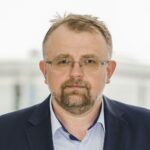
The Institute of Physics of the Slovak Academy of Sciences (IP SAS) invites you to a physics colloquium entitled Magnetoelectric Phenomena of Non-Centrosymmetric Superconductors, presented by Dr. Denis Kochan, who will discuss magnetoelectric effects arising from spin–orbit coupling and finite-momentum Cooper pairing in non-centrosymmetric superconducting systems. The lecture is open to the entire scientific community, including researchers, students, and all those interested in contemporary superconductivity and quantum materials.
Magnetoelectric phenomena of non-centrosymmetric superconductors
Superconductivity in materials lacking inversion symmetry has been a topic of intense theoretical and experimental interest due to the unique effects of spin-orbit coupling on electronic bands. Spin splitting corroborated with magnetic/exchange field can lead to novel pairing states, such as the helical phase, characterized by Cooper pairs with finite center-of-mass momentum. This property gives rise to intriguing magneto-electric and magneto-chiral effects, including the enhancement of critical temperature in magnetic fields, supercurrent diode effects, and anomalous Josephson phenomena. In recent years, synthetic superconductors, such as two-dimensional electron gases with strong Rashba spin-orbit coupling have provided a platform to explore these phenomena and search for topological superconducting states.
This talk will present an overview of non-centrosymmetric superconductivity, covering main theoretical concepts and key experimental observations, including:
- Supercurrent diode effect and Josephson inductance anisotropy in InAs-quantum well-based junctions [1].
- Zero-pi-like transitions and anomalous Josephson effect in non-centrosymmetric systems [2].
- Enhanced vortex pinning and squeezing in Rashba-based superconductors [3].
- These phenomena are attributed to the Lifshitz invariant [4] in the Ginzburg-Landau free energy, which arises from the finite center-of-mass momentum of Cooper pairs.
References
- C. Baumgartner et al., Nature Nanotechnology 17 (1), 39 (2022)
- A. Costa et al., Nature Nanotechnology 18 (11), 1266 (2023)
- L. Fuchs et al., Physical Review X 12 (4), 041020 (2022)
- D. Kochan et al., arXiv:2303.11975
Denis Kochan, PhD.
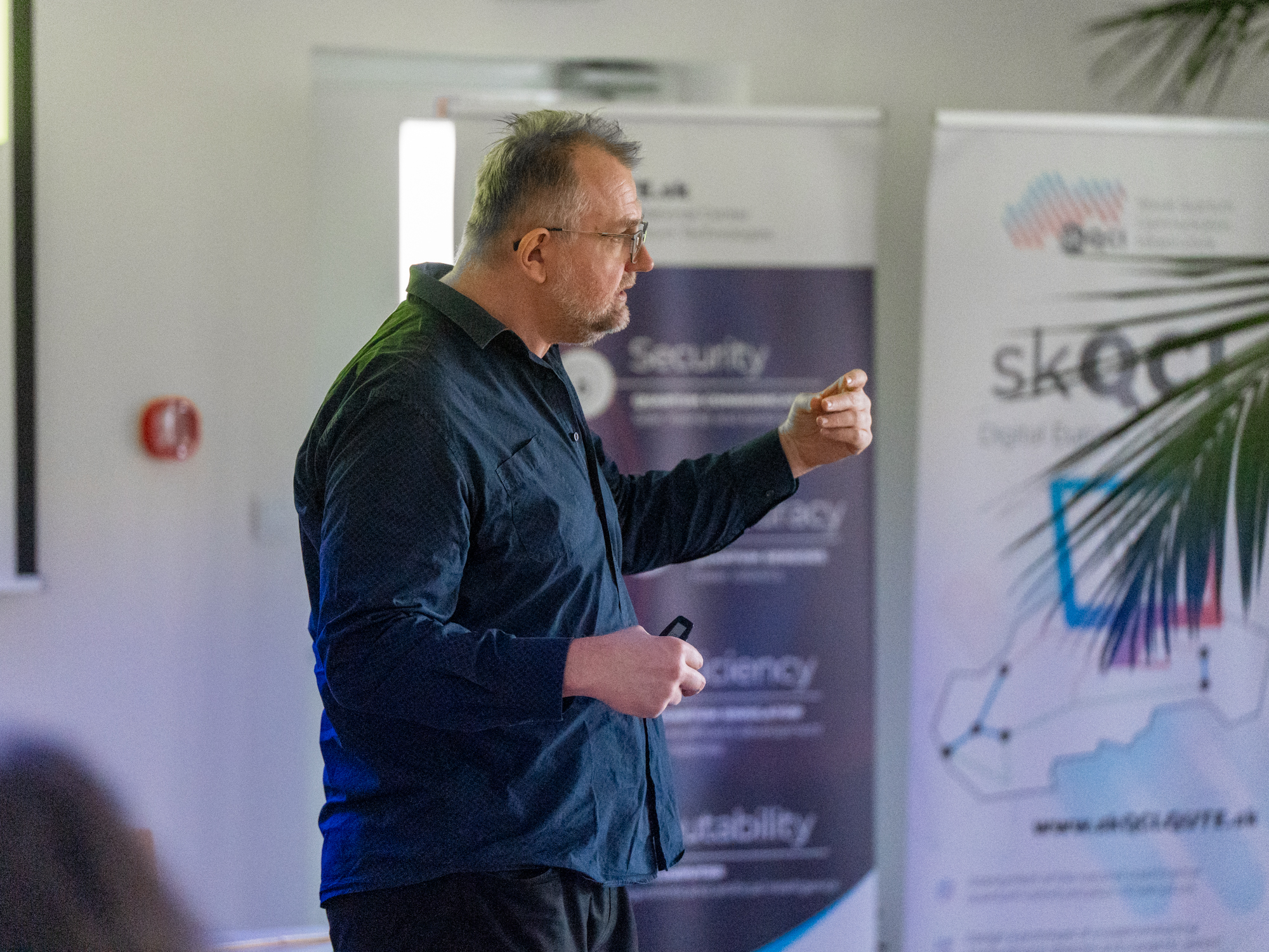
Dr. Denis Kochan from Institute of Physics of Slovak Academy of Sciences is recognized for advancing our understanding of spin-orbit coupling (SOC) and nonreciprocal superconductivity, most prominently through his contributions to the superconducting diode effect (SDE) and related magnetoelectric phenomena. His theoretical insights, developed in close collaboration with experimental groups have helped to explain key observations of the supercurrent diode effect, Josephson inductance anisotropy, and anomalous Josephson responses in Rashba-based superconductors. Denis Kochan studied theoretical and mathematical physics at Comenius uUiversity. After finishing his PhD on differential geometry he changed research field to condensed matter phenomena. He spent his postdoc years at University of Regensburg. Receiving the prestigious IMPULZ fellowship has attracted him to return to Slovakia.
AboutThe project skQCI is funded by the European Union from the Digital Europe Programme and the NextGenerationEU Programme from the Recovery and Resilience Plan of the Slovak Republic.